Apparel Boxes
 CBD Boxes
 Electronic Boxes
 Jewelry Boxes
 Christmas Boxes
 Soap Boxes
 Bottle Boxes
 Hardware Boxes
 Health Boxes
 Product Boxes
 Pharma Boxes
 Holiday Boxes
 Shipping Boxes
 Pre Roll Boxes
 Pizza Boxes
 Vape Boxes
 Hemp Boxes
 Cereal Boxes
 Bakery Boxes
 Stationery Boxes
 Sports Boxes
 Chocolate Boxes
 Retail Boxes
 Gift Boxes
 Candle Boxes
 Food Boxes
 Tea Packaging
 Cigarette Boxes
 Cosmetic Boxes
 Coffee Packaging
 Cardboard Boxes
 Corrugated Boxes
 Rigid Boxes
 Kraft Boxes
 Custom Tote Bag
 Custom Mylar Bags
 Gable Boxes
 Hang Tags
 Labels & Stickers
 Mailer Boxes
 Paper Bags
 Pillow Boxes
 Trays and Sleeves
 Tube Packaging
 Tuck Boxes
 Window Packaging Boxes
 Display Boxes


A few years ago I ordered a pair of headphones online. Nothing fancy. By the time the box showed up, one corner had already caved in. The headphones themselves were totally fine, not a scratch on them, but I remember hesitating the next time I was about to order from that same store. Weird, right? The product had nothing wrong with it. It was just the box.
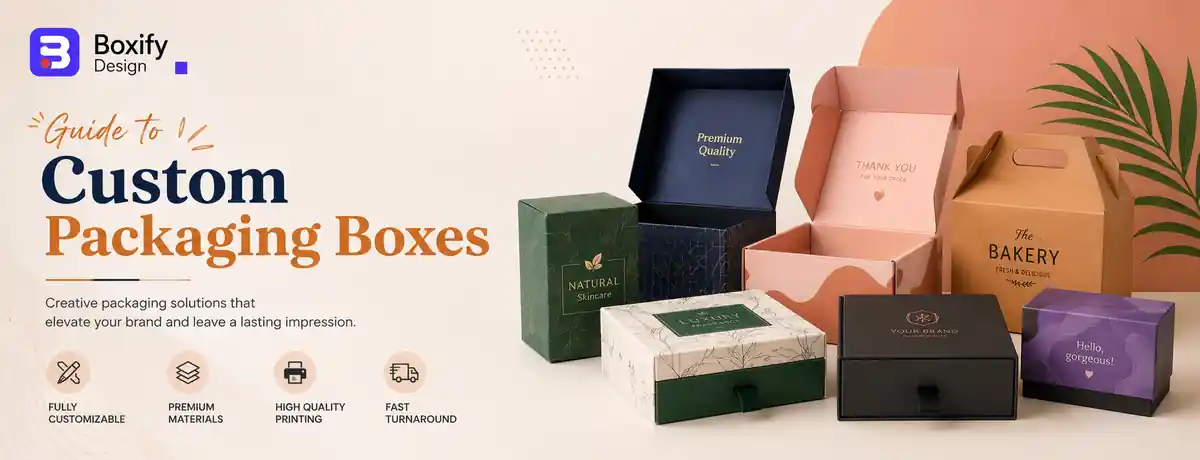
That's kind of the point of this whole guide. Packaging does something to people that's hard to explain but easy to feel. So let's get into it: what custom packaging boxes actually are, why businesses spend real money on them, the different box types floating around, the materials, the finishes, and how you'd go about picking the right one for your own product. Long read, so settle in.
What Custom Packaging Actually Means
Custom packaging, put simply, is a box built around your product instead of grabbing whatever's closest on a shelf. You get to decide the size, the shape, what it's made of, what gets printed on it, and honestly even how it feels when someone picks it up.
For some brands that's just a logo stamped on a plain box. Done. For others it turns into a whole project, inserts shaped to hold the product snugly, a little window cut into the front, magnetic flaps, printing on literally every surface inside and out. There's no rule for how far you need to take it. The only thing that really matters is that it doesn't feel like an afterthought slapped together at the last minute.
Why Does Any of This Actually Matter?
Here's something I've noticed. A lot of business owners treat packaging like it's just another cost to shrink. Cheapest box available, get it out the door, move on to the next order. And look, for some products that's genuinely fine. Nobody's judging a bag of screws by its packaging. But if you're building a brand people actually remember, packaging is doing more work than most people give it credit for.
Take unboxing videos. They're everywhere now, people filming themselves opening a delivery and posting it, sometimes to a huge audience, sometimes to nobody in particular. Either way your box gets a few seconds in the spotlight before the actual product is even visible. A box that feels put-together builds a little bit of excitement. One that shows up dented, or looks like it got recycled from a clearance bin somewhere, works against you before you've had a real chance.
Then there's just plain recognition. Keep your colors and logo consistent order after order and people start knowing your brand on sight, sitting on a porch, stacked in a delivery pile, wherever. Doesn't happen in one order. Builds up slowly.
Protection is the boring reason, but honestly it might be the biggest one. A box shaped around your actual product keeps things from sliding around during a rough truck ride. I've watched businesses stuff a way-too-large box with bubble wrap trying to make up for the fact that the sizing was wrong from the start. It kind of works. It's just more expensive and less reliable than getting the dimensions right in the first place.
And don't sleep on the marketing side either. A QR code tucked inside the lid, a small handwritten-style thank you note, a discount code for next time, none of that costs much, and it genuinely nudges people toward buying again. Some brands take it further and use the box to talk about what it's made from, recycled content, soy inks, less plastic tape, because plenty of shoppers are actually paying attention to that stuff now.
The Main Types of Boxes
.webp)
You don't need to know every type out there. What matters is what fits your product and how far it has to travel.
Corrugated boxes are the default for most online stores. Fluted cardboard sandwiched between liner sheets, tough enough to survive stacking and rough handling and whatever chaos happens inside a shipping warehouse. If you ship in any real volume, this is probably already what you're using.
Rigid boxes are the step up. Thicker, sturdier, and they just feel expensive the second you hold one. Electronics, jewelry, cosmetics, gift sets, anything meant to signal value tends to use these. They don't fold flat for shipping so they cost more, but for the right product that extra cost earns its keep.
Folding cartons use thinner paperboard and show up constantly on retail shelves, cereal, cosmetics, over-the-counter meds. They ship flat and get folded into shape right before packing, which honestly saves a shocking amount of warehouse space.
Kraft boxes have that raw, unbleached paper look. Brands going for a natural or handmade feel, small-batch coffee, candles, soap, that kind of thing, tend to reach for kraft over anything glossy.
Mailer boxes are the one-piece, self-locking kind you've probably torn open without ever thinking about it. Most designs skip tape entirely. Clothing brands and subscription boxes lean on these heavily because they're quick to assemble and cheap to ship.
Window boxes have a cutout, sometimes plastic-covered, sometimes just an open die-cut, so people see the product before opening anything. Works great for food, toys, anything where the visual is part of the sell.
Display boxes pull double duty as an in-store fixture too. Built so a retailer can just set it on a counter and let it act as its own little display stand.
What They're Made Of
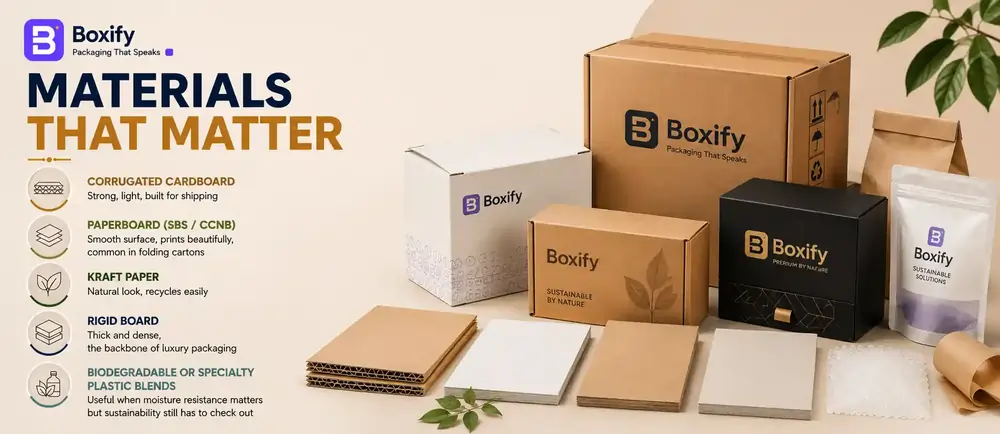
Material affects more than just how it looks. Some common options:
- Corrugated cardboard: strong, light, built for shipping
- Paperboard, sometimes called SBS or CCNB: smooth surface, prints beautifully, common in folding cartons
- Kraft paper: natural look, recycles easily
- Rigid board: thick and dense, the backbone of luxury packaging
- Biodegradable or specialty plastic blends: useful when moisture resistance matters but sustainability still has to check out
Printing and Finishing Options
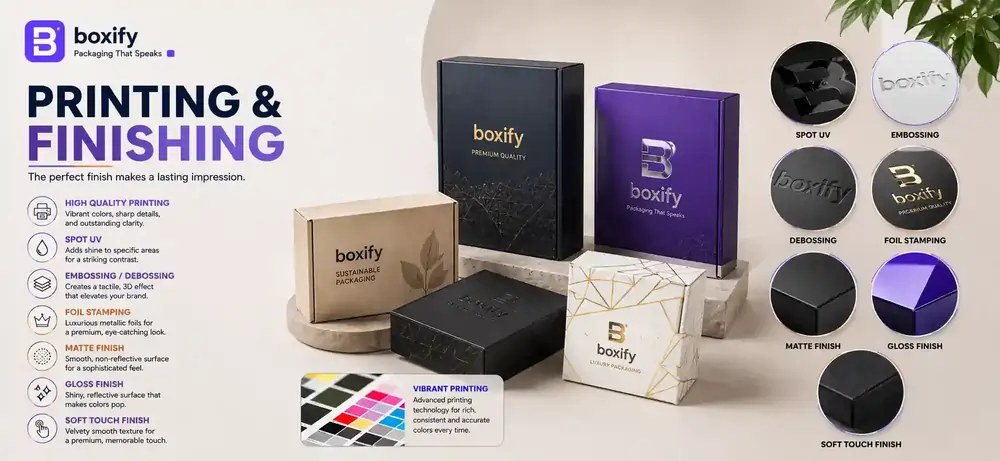
This is where a box stops being just a box. A few finishes worth knowing:
- Offset or digital printing for full color art and photography
- Embossing and debossing, raised or pressed-in texture you can actually feel
- Foil stamping for a metallic accent, gold or silver usually
- Spot UV, a glossy layer over specific design elements against a matte background
- Matte or gloss lamination for extra durability and shine
- Die-cut shapes or windows for something structurally different
None of this is required. A lot of genuinely great packaging is just clean printing and good typography, nothing fancy. You don't have to throw every finish at a box just because it exists.
How to Actually Pick the Right One
Start with the product itself, not the design. A ceramic mug needs completely different support than a folded t-shirt, and no amount of nice printing fixes a box shaped wrong for what's inside it.
Be honest with yourself about the budget. Rigid boxes and premium finishes get expensive fast, especially once you're shipping hundreds or thousands of orders a month. Worth asking whether the fancy feel actually changes whether someone buys, or if it's more about ego than return on investment.
Think about the trip the box has to survive, not just how it looks sitting still. A local delivery is a completely different test than cross-country shipping through several sorting facilities. If you haven't stress-tested your packaging, shaken it, dropped it, thrown it in a car trunk, do that before committing to a big print run. Boring step. Skipped constantly. Saves the most headaches later, though.
Make sure it actually feels like your brand. Sounds obvious but I've seen businesses order packaging that has nothing in common with their website or product photos. If your brand is quiet and minimal, don't grab neon packaging just because that print run happened to be cheaper.
Take sustainability seriously if your audience does. Not everyone cares the same amount, but for a lot of shoppers now, recyclable materials and less plastic genuinely factor into where they spend.
And plan your order sizes carefully. Custom packaging almost always has a minimum order quantity, and the per-unit price drops a lot once you scale up. Order too little and you're reordering constantly. Order too much and you've got a storage closet full of boxes for a product you might redesign in six months anyway.
Mistakes People Keep Making
A handful of things trip up almost everyone eventually:
- Getting the size wrong, either wasting money on something too big or risking damage with something too small
- Overdesigning until it's cluttered and hard to read at a glance
- Skipping the physical sample and jumping straight to a full production run
- Underestimating how long specialty finishes take, weeks sometimes, not days
- Forgetting that food, cosmetics, and pharma products come with actual labeling rules that need to be baked into the design early, not bolted on later
What Should You Expect to Pay?
Cost depends on material, size, print complexity, and how many units you're ordering. Rough guide: folding cartons are usually cheapest, corrugated mailers sit in the middle, and rigid boxes with premium finishes cost the most but also deliver the strongest "this feels expensive" reaction when someone opens it.
It's worth shopping around for a supplier who's upfront about pricing tiers and actually willing to walk you through trade-offs, instead of just pushing their priciest option. That one conversation alone can save a surprising amount of money.
Where This Leaves You
Packaging isn't just the thing a product sits in until it arrives. For a lot of brands it's turned into one of the most effective tools they have, and one of the most overlooked. It protects what's inside, it says something about who you are before anyone's read your website, and it can create a small moment of delight that a plain cardboard box never will.
If you're just starting out, you don't need the fanciest option right away. Get the size right, make sure it protects the product, and let the branding get more elaborate as your budget grows. The point was never to impress yourself. It's to give whoever's about to open that box a real reason to remember you.